
How to Stop Living in Urgency Mode
Letter Ø39: Calm isn’t laziness, it’s leadership over your nervous system.

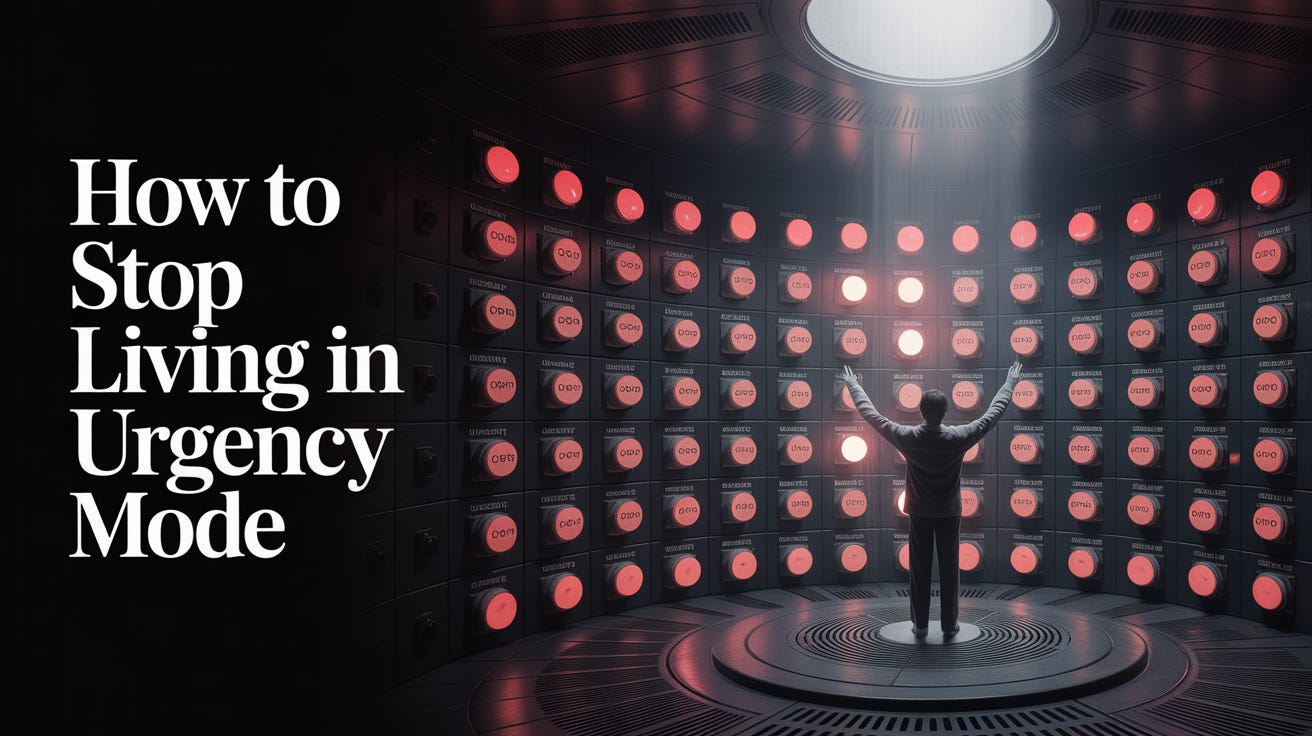
You probably know that feeling, that low-level buzz under your skin, that pressure to do more, answer faster, decide now.
You’re not sprinting, but your body thinks you are.
Your mind is juggling, calculating, anticipating.
Your breath is shallow. Your shoulders are tight.
You’re not in danger, but your nervous system doesn’t know that.
Welcome to urgency mode.
The Culture That Keeps You on Alert
In America, we’re raised to move fast.
We equate speed with success, hustle with ambition, exhaustion with importance.
“Urgent” becomes our default setting.
We rush to reply to emails, texts, and even thoughts.
We check our phones like it’s oxygen.
We keep score by how busy we sound.
But here’s the quiet truth:
Urgency is not the same as importance.
It’s just adrenaline wearing a suit.
What Urgency Really Is
Urgency mode is your body’s stress system, the fight-flight loop, stuck in “on.”
It’s not just psychological; it’s biological.
When you live in urgency, your body constantly releases cortisol and adrenaline.
That’s why you feel jittery, tense, wired, and tired all at once.
You can’t focus deeply in this state.
You can’t rest fully either.
You’re always halfway somewhere, never fully here.
Your body thinks it’s protecting you, but really, it’s exhausting you.
The Cost of Always Being “On”
Urgency mode doesn’t just drain your energy, it distorts your perspective.
You start treating everything like an emergency.
A message left unread feels like failure.
A delay feels like danger.
Rest feels like rebellion.
You start reacting instead of choosing.
You start surviving instead of living.
That’s not leadership.
That’s panic dressed up as productivity.
The Practice of Slowing Your Internal Clock
Getting out of urgency mode isn’t about doing less, it’s about moving with awareness.
It’s about reminding your body: We’re not in danger anymore.
Here’s how you start reclaiming that calm, one pause at a time.
1. Notice the False Fires
Ask yourself:
“What’s actually urgent here, and what just feels urgent?”
Nine times out of ten, your body is reacting to perceived pressure, not real threat.
Name the difference. It’s a form of freedom.
2. Breathe Before You React
When your heart races, your breath is your steering wheel.
Try this:
Inhale slowly for 4 seconds.
Exhale for 6.
That longer exhale tells your body, We’re safe.
It slows your heart, clears your mind, and returns control to you.
3. Practice the “Not Yet” Rule
When you feel the urge to answer immediately, try waiting.
Five minutes. One hour. Maybe even tomorrow.
Urgency mode loses its grip when you realize that most things don’t fall apart if you pause.
4. Redefine What “On Time” Means
You don’t owe the world your constant availability.
Your pace doesn’t have to match anyone else’s.
In fact, the more calmly you move, the more effective you become.
Urgency scatters energy.
Presence channels it.
Why Calm Is Leadership
Calm isn’t passivity. It’s precision.
It’s the ability to act from intention, not impulse.
In a world addicted to urgency, your calm becomes an act of quiet power.
You can’t lead — not your work, not your relationships, not your own mind, if you’re constantly reacting.
But when you slow down, you see clearly. You choose better. You respond, not just react.
That’s not laziness. That’s mastery.
Tiny Prompt for Today
“What am I treating like an emergency that isn’t one?”
Write down one thing.
Then breathe. Step back. Give it space.
You might find it wasn’t urgent after all.
You don’t have to live in constant alert mode.
You don’t have to answer life as fast as it asks.
The world won’t collapse if you take a breath.
But you might, in the best way, begin to expand.
– Mindful Letters
P.S. The calm you think you don’t have time for is the very thing that will give you back your time.